


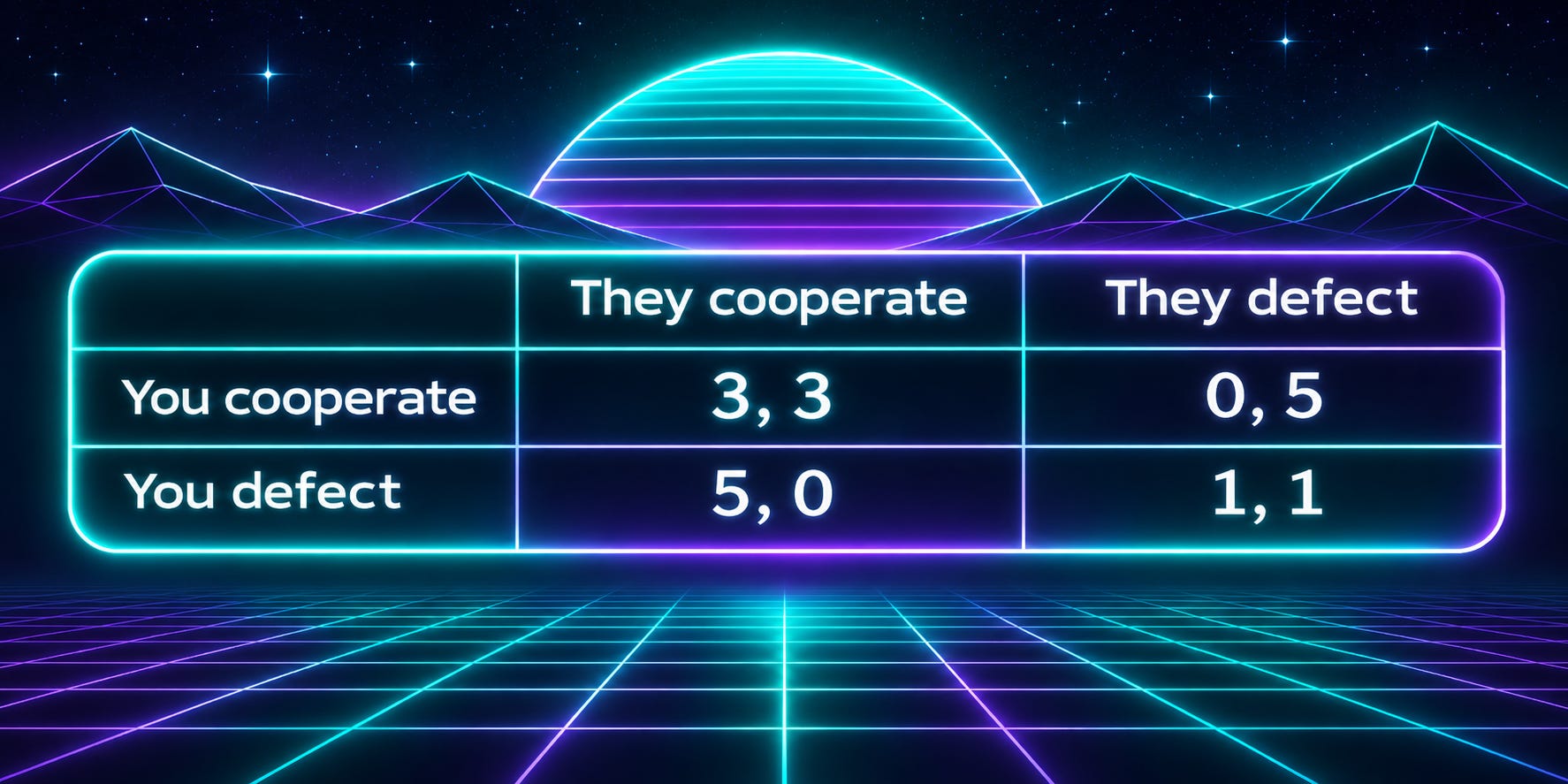
This week’s uplifting Win-Win story is all about game theory: specifically, how a 1980s algorithm design contest revealed a beautiful truth about human cooperation
Split Or Steal?
The classic prisoner’s dilemma: two players are faced with a choice whether to cooperate or defect in a game. They don’t know what the other will choose, but they do know that if both cooperate, they’ll get an equal, modest prize. If one defects while the other cooperates, the defector gets heavily rewarded, and the cooperator gets screwed.
And if both defect? Both get screwed.

Given that 5 > 3, the “rational” move in any one-off game is to defect... (and for those who saw me on that show Goldenballs twenty years ago, game theory is why I “stole” the prize: it was a classic one-shot prisoner’s dilemma, and “steal” was the mathematically optimal play (especially to an aspiring young poker player who had just learned to see the world through the lens of maximizing $ returns).
But life is not a one-off prisoner’s dilemma on a gameshow. Even in the cold hard worlds of business & finance —which are notorious for backstabbing and deal-breaking — you often face the same “opponents” over and over in negotiations, which means they are more like repeating prisoner’s dilemmas.
In repeating dilemmas, cooperation have been mathematically shown to vastly outperform selfishness in the long run. And one famous cooperative strategy stands heads and shoulders above them all…
Battle of the Algorithms
In 1980, political scientist Robert Axelrod tried to answer the question of which strategy is best by getting 14 teams of scientists to submit computer programs (algorithms) to play 200 rounds of iterated (repeated) prisoner’s dilemma against each other, round-robin style.

Some programs were quite complex, like the “Tullock”, which “cooperated on the first 11 moves, then randomly cooperated 10% less than its opponent in the previous 10 rounds”… whatever that means.
But the winner, oddly enough, was one of the simplest: Tit-for-Tat.
Tit-for-Tat just means: cooperate on the first move, and then just copy whatever the other guy did in the previous round. Extraordinarily simple as algorithms go, yet it performed better over the long run than all the selfish strategies and the hyper-friendly “always cooperate” ones.
It even won again in a second, larger tournament of 62 teams, many of which were designed specifically to beat Tit-for-tat.
Even crazier, it won the overall tournament top despite never outscoring any single opponent. In fact, its best head-to-head result was a tie. So how did it still win?
Nice Guys Finish First
Axelrod boiled T-F-T’s success down to these four principles:
Nice: never be the first to defect
Retaliatory: punish defection immediately to keep opponents in line
Forgiving: resume cooperating as soon as the other guy does
Clear: be predictable enough that others can learn that cooperation pays off
These make intuitive sense if you think about it: if you are too defecty & selfish from the get-go (or chaotic and unpredictable) people won’t trust you. But if you never punish defection against you, you’ll always get exploited. But if you hold a grudge for too long, you’ll miss out on all the benefits of mutual cooperation.
This elegant balance is what makes T-f-T so successful, because it draws out cooperation across matchups in ways that other strategies can’t… mathematical verification that positive-sum attitudes beats zero-sum over the long run.
Axelrod called this the “shadow of the future”, where the longer and more certain the relationship (the shadow), the more attractive cooperation becomes. His favourite IRL example was the “live and let live” system that spontaneously emerged in the WWI trenches, where despite orders (and the hellscape they were living in), many opposing units often agreed to ceasefires, and even laid down their arms to play football and exchange gifts on Christmas Day.
Caveats
Now to be clear, tit-for-tat isn’t universally perfect. Later research showed it can get trapped in endless revenge spirals in noisy situations, e.g. when its opponents defect by accident, which often happens in real life. It simply lacks the intelligence to spot and adapt to unintentional defections. Not surprising, given it is just a simple algorithm.
Indeed, a 2025 rerun of Axelrod’s tournament with more modern “learning” algorithms (which could model and adapt to their opponents more accurately) easily beat it. But still, they also followed the four Nice-Retaliatory-Forgiving-Clear principles, which is another data point for their philosophical value.
Takeaway
In repeated games, cooperation isn’t naive. It’s a legit winning strategy that strictly dominates selfishness.
So if we want more cooperation in the world, it’s not enough to just preach “be nice!”... we also have to design systems that allow for repeated interactions in the first place. Systems that make reputations visible, defection costly, and forgiveness viable. Or as Axelrod would say: systems that lengthen the shadow of the future.
In fact, many of our problems today are precisely because we’ve shortened the shadow: anonymous online interactions, noisy information ecosystems, quarterly earnings reports etc… modernity has largely turned repeated prisoners dilemmas back into one-shot games, which is Moloch’s dream.
The win-win move is to make those games long again.
Sources: Axelrod, The Evolution of Cooperation (via EPFL summary) · Tit for tat · Rapoport, Seale & Colman, “Is Tit-for-Tat the Answer?”
I never tire of preaching the good news of TfT